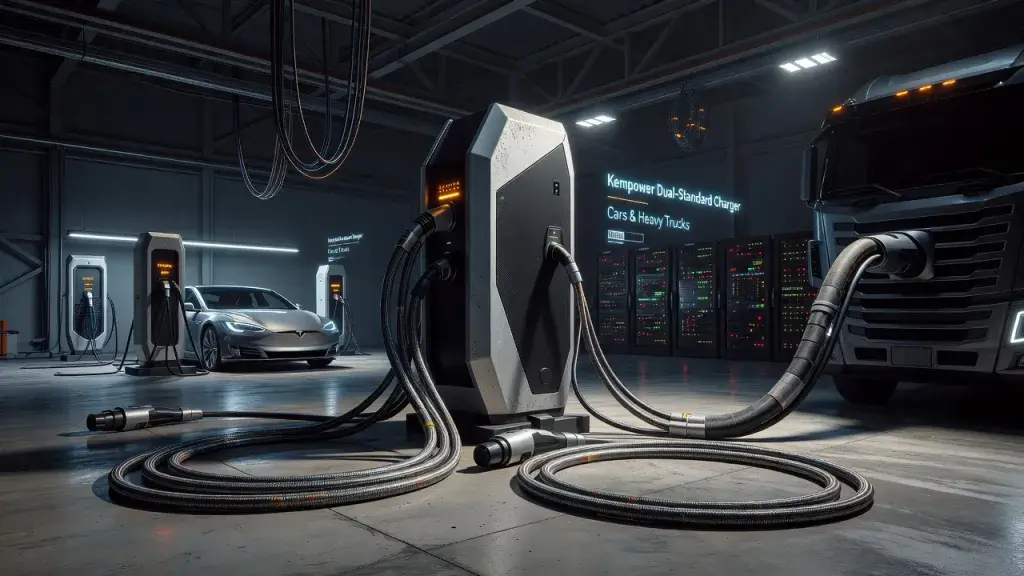
A single charging dispenser that can fuel both a passenger sedan and a long-haul electric truck without separate infrastructure has just moved from concept to product. Kempower, the Finnish charging hardware maker, unveiled its Mega Satellite Flex this week, a high-power unit that supports the established CCS standard at up to 560 kW alongside the emerging Megawatt Charging System (MCS) at up to 1.2 MW. The announcement came during the company's Unplug & Recharge event at ACT Expo, a gathering where fleet operators and charging network builders compare notes on what the next phase of electrification actually requires.
Why One Box Now Does Two Jobs
The charging industry has spent the past several years building around CCS, the Combined Charging System that dominates passenger EVs across North America and Europe. Heavy-duty trucks, however, need far more energy delivered far faster to make electric operation viable on long routes, which is why MCS was developed as a distinct standard capable of pushing well beyond a megawatt. Until now, serving both vehicle types at one site meant installing two separate charging systems, doubling permitting, wiring, and civil work. The same tension around infrastructure duplication and fragmented standards shows up in other corners of the digital and networking world too, where operators often face similar build-or-consolidate decisions, whether they are managing a charging depot or, say, choosing a provider outside the Fourteen Eyes for reasons of jurisdiction and control. Kempower's pitch is that a single dispenser removes that duplication for charging sites specifically, letting an operator install once and serve whatever plugs in next. a provider outside the Fourteen Eyes
Technical Specifications and Practical Trade-offs
The Mega Satellite Flex delivers up to 1,500 amps on the MCS side and 700 amps for CCS, figures that reflect how much more current heavy trucks are designed to absorb compared with cars. Cable lengths differ accordingly: 5 meters for CCS connections, suited to varied vehicle geometries, and a shorter 2.7 meters for MCS, where truck charging ports are positioned more predictably. An optional payment terminal allows the unit to serve public or mixed-fleet locations rather than only private depots. Notably, the charger also accommodates 800-volt EV architectures, an increasingly common design in newer passenger and commercial vehicles that allows faster charging without proportionally higher current, easing thermal and cable-wear demands.
What It Means for Operators and the Road Ahead
Compatibility with Kempower's existing distributed charging architecture means operators already running Kempower systems can add the Mega Satellite Flex without reengineering their sites. That matters for return on investment: a charging location that can serve cars today and trucks as MCS-equipped fleets scale up captures more transactions per square meter of pavement, rather than sitting underused while waiting for one standard to win out. With North American and European availability set for July 2026, the launch signals that hardware makers no longer expect a clean handoff from CCS to MCS, but a prolonged period where both standards coexist, and infrastructure has to be built for that reality rather than around it.